







If Your Drink Ads Aren't Performing - Fix This.
The Real Reason Your Drink Ads Don't Convert (It's Not Your Creative)
Most drink brands think their Meta ads are underperforming because of budget, because of creative, because the algorithm changed. I used to think that too.
It's none of those things.
I know that sounds wrong. Bear with me.
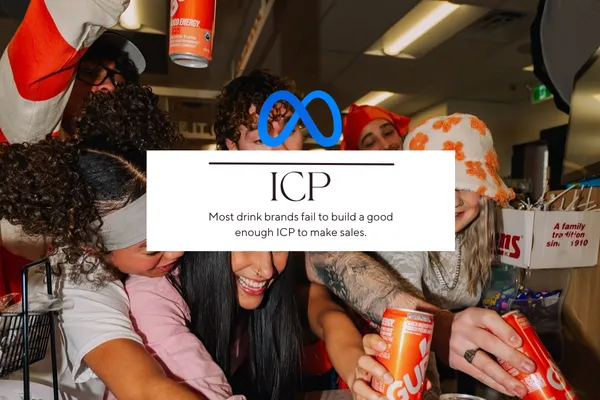
The real problem is that most drink brands are advertising to a category of person — not a specific human being. And Meta's algorithm is ruthless about the difference. You can have a gorgeous product shot, a punchy hook, a $10k/day budget, and still bleed money if the message isn't built around someone real. The algorithm finds buyers when your signal is strong. Your job is to give it a strong signal. That starts with your ICP.
What Most Drink Brands Actually Do
I was auditing the ad account of a functional beverage brand — solid product, clean packaging, genuinely good ingredients. Their targeting was textbook: ages 25–45, interest in health and wellness, fitness, nutrition.
Their ads said things like: "Clean energy. No crash. Feel your best."
CTR was flat. CPA was climbing. They kept making new creatives, cycling through variations of the same message to the same blurry audience.
The issue wasn't the ads. It was that they'd never actually decided who the ad was for.
When you define your audience as "health-conscious adults," you write ads for nobody. You get generic creative because you have a generic customer. And generic creative dies fast on Meta — it gets ignored in the first half-second, which tanks your relevance score, which raises your CPM, which kills your CPA. It's a chain reaction that starts with a vague ICP.
The Four Variables That Actually Matter
Forget demographics for a moment. Meta's algorithm doesn't need you to hand it a 35-year-old woman who follows yoga accounts. It needs a creative that makes the right person stop scrolling and feel something specific: This is for me.
To create that, you need to understand four things about your buyer.
Their current situation. Not age and zip code — their actual day. Are they a night-shift worker grabbing something before a 12-hour shift? A mom trying to stay functional through school pickups and a Zoom call at 3pm? A guy who used to train hard and is trying to get back to it? The situation is the scene your ad walks into.
Their pain point. Not the category of the problem — the way they live it. There's a huge difference between "I'm tired" and "I hit a wall every afternoon and I can't afford to, because my whole evening is still ahead of me." That second version is a hook. The first one is noise.
Their desired outcome. Not the feature. The feeling. They don't want "120mg of natural caffeine." They want to feel sharp at 2pm without the jitters, without the crash, without the guilt of reaching for something processed. Sell the outcome, not the ingredient stack.
Their constraint. What's stopped them from solving this already? Maybe they've tried coffee and it wrecks their stomach. Maybe they've tried energy drinks and they don't trust the label. Maybe they think functional drinks are overpriced. That constraint is your objection-handling — it needs to be in the ad, not just on the landing page.
When you know all four, the ad almost writes itself. The pain becomes your hook. The constraint becomes your credibility. The desired outcome becomes your promise.
How This Translates Directly to Drink Ad Creative
Let's make this concrete. Say you're selling a clean energy drink targeting people who work demanding jobs but are health-aware.
Vague ICP → generic ad: "Feel energized, all day. Clean ingredients. No crash."
Specific ICP → specific ad: "I used to need two coffees before 10am just to function. Now I drink one of these at 7 and I'm good until lunch. No stomach thing. No crash at 3. Just steady."
The second one is a UGC testimonial built entirely from the ICP's lived experience. It names the situation (morning dependency), the pain (stomach issues, afternoon crash), and the outcome (steady energy). That ad earns attention because it describes a real person's life back to them.
That's message-market match. And it's the single biggest lever on your CTR and conversion rate — bigger than your offer, bigger than your creative format, bigger than your budget.
When someone watches your ad and thinks they understand exactly what I'm dealing with, your CPA drops. Sometimes dramatically. Because Meta reads the engagement signal and finds more people just like them.
The Testing Framework This Creates
Once you have a tight ICP, your testing becomes systematic instead of chaotic.
You're not testing "does video work better than static?" You're testing angles. Each angle is a different entry point into the same buyer's world.
For a drink brand, those angles might be:
The skeptic angle: "I didn't think a drink could actually do X. Then I tried this."
The routine angle: "This replaced my 3pm coffee. Here's why I haven't gone back."
The ingredient angle: "Most energy drinks have [bad thing]. This one doesn't. Here's what it has instead."
The occasion angle: "Before every workout / every early morning / every long drive, I drink this."
Each of these speaks to the same ICP from a different emotional entry point. You run them against each other. The one with the lowest CPA at a statistically meaningful sample (usually 50+ conversions per ad) wins and gets more budget. The others get cut or retooled.
This is how you build a creative testing system — not by guessing what looks good, but by systematically testing which angle of your ICP's life resonates most.
What You Launch First
Don't overthink the starting lineup. Pick one ICP — just one. The person most likely to buy, most likely to reorder, and most likely to tell someone else.
Build three ads, each one a different angle into that person's life. Run them with equal budget in the same ad set. After 150–200 clicks per ad, you'll have signal. One will be pulling ahead on CTR. One will be converting cleaner on CPA. That's your control creative.
Scale the control. Test a new angle against it next week. Repeat.
This is predictable customer acquisition. Not hacks. Not tricks. Just a clear picture of one real human being, and a system for finding more of them at a cost that makes your unit economics work.
Know your buyer better than your competitors do. That's the whole game.